3. Mapping the Ring of Fire
Plotting the latitude and longitude of quakes and eruptions in this activity will help you piece together some of the same patterns that scientists used to establish the theory of Plate Tectonics.
This activity also gives you a chance to practice doing your own research. Being able to look up and evaluate information is an essential skill!
To know whether a website is a good resource, use this reliability checklist:
-
Who made it? Is the site from a scientist, university, or government agency? Is it made by a museum or other organization with a reputation for quality and accuracy? If the answer to this question is "a stranger on the internet," proceed with skepticism!
-
What evidence does it use? Does the website provide references to its data or measurements? Is there some way you can verify or double-check the information?
- Why was it published? Is it mainly to inform/teach? Or is it just trying to get attention? If a website has a host of adds or click-bait titles, that's evidence that it exists to drive clicks or sell things. It's not likely to contain trustworthy information.
-
Can you confirm it? For scientific topics, check to see what other trustworthy sources such as USGS, NOAA, and universities say. You should be able to confirm the information there.
As an example, let's ask these questions about the two sites we recommend for learning more about the rint of fire:
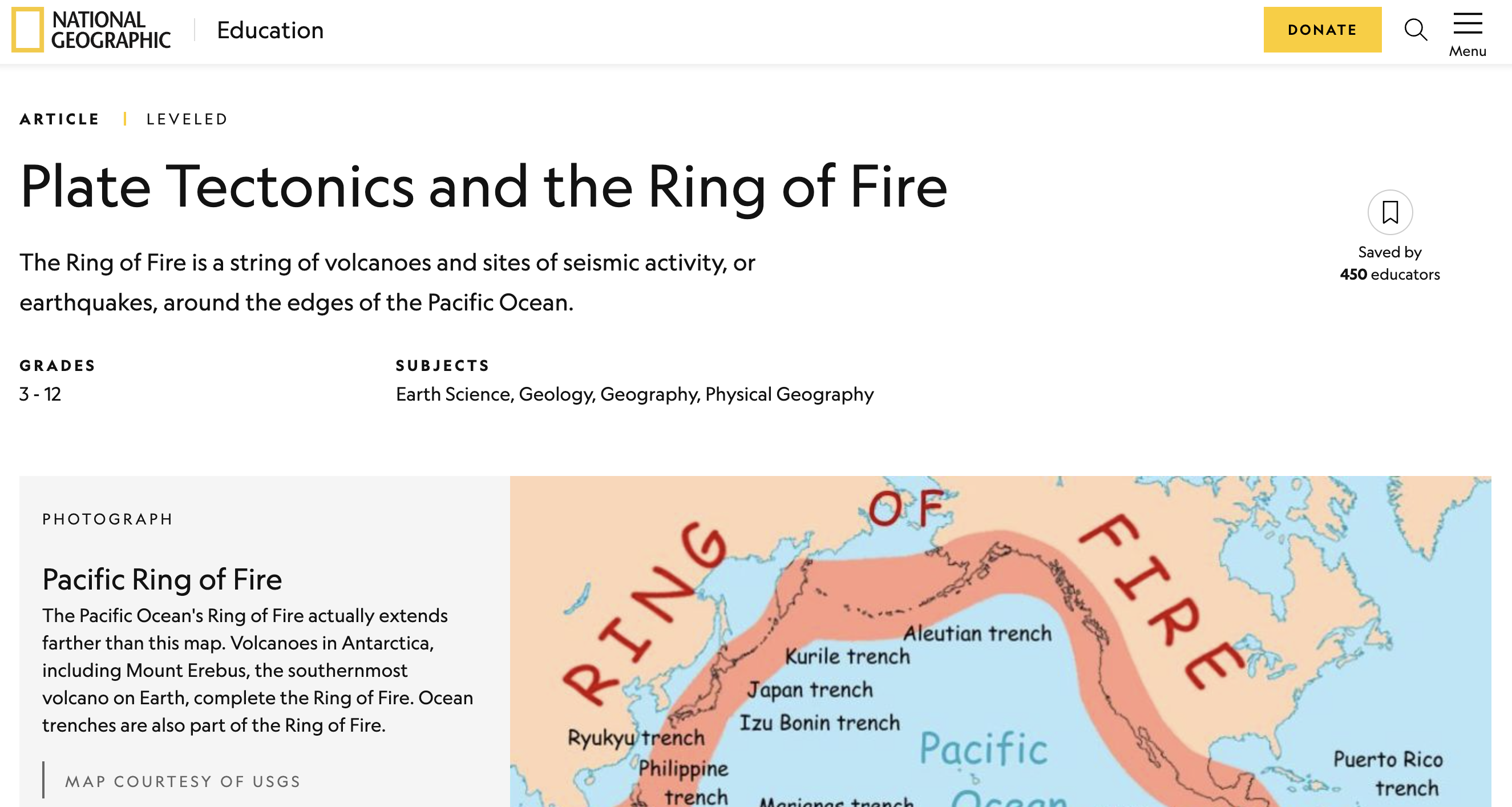
SOURCE 1: National Geographic Ring of Fire website https://education.nationalgeographic.org/resource/plate-tectonics-ring-fire/
- Who made it? The National Geographic Society, founded in 1888. It's one of the largest and oldest scientific nonprofit organizations.
- What evidence does it use? Maps, scientific data from USGS, NOAA, FAO, Global Volcanism Program, and ESRI.
- Why was it published? It's designed to support classrooms with a free scientific resource. It's not not designed to sell a product or gather clicks.
- Can you confirm its information? Yes. The information on the website can be verified by scientific agencies such as USGS, NOAA, and the Smithsonian Institute's Global Volcanism Program
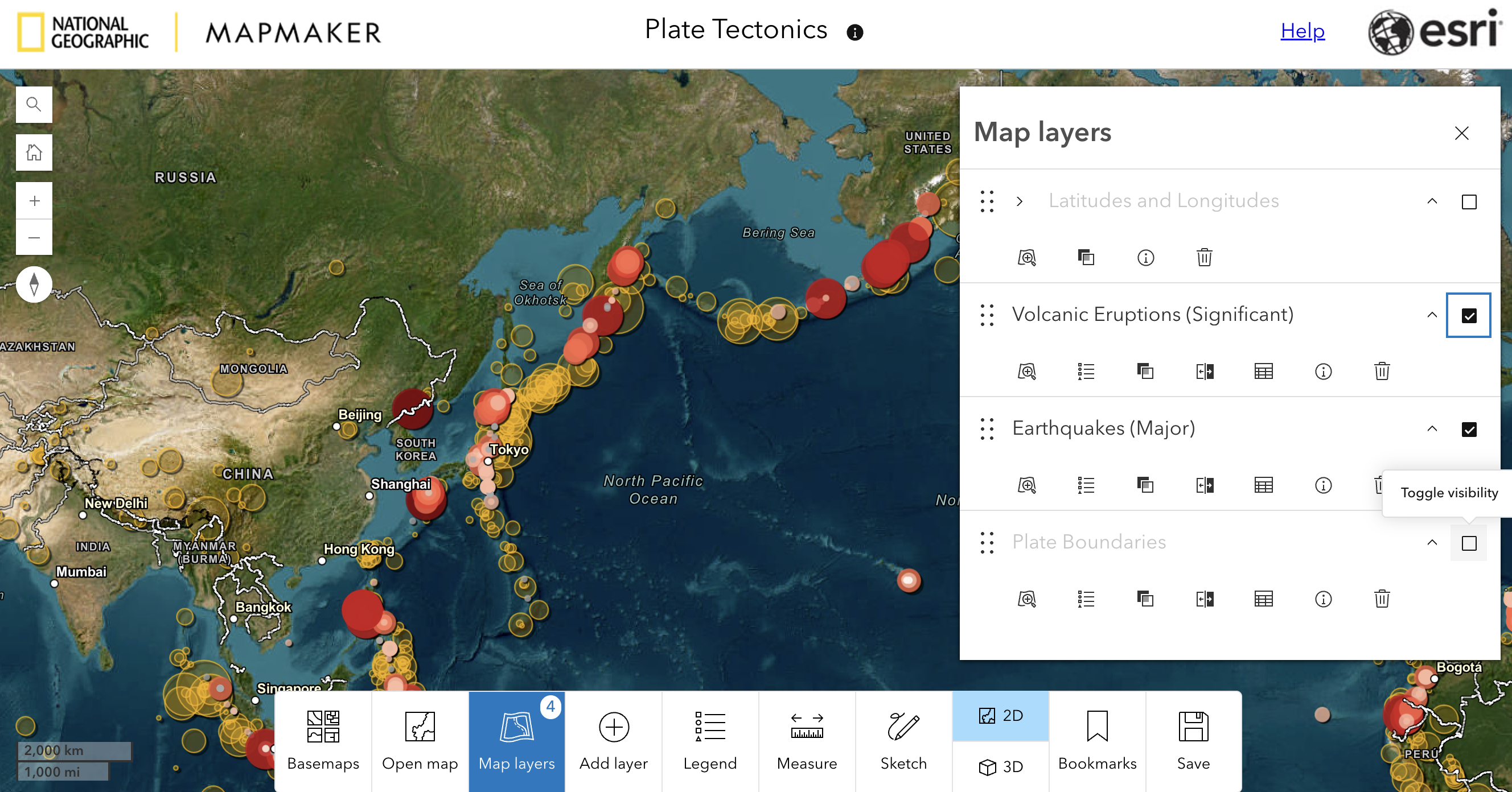
Note: the National Geographic site also links to an excellent map tool where you can add different layers and see how plate boundaries, volcanic activity, and earthquakes occur.
SOURCE 2: United States Geological Society (USGS) Ring of Fire website (https://www.usgs.gov/faqs/what-ring-fire) and earthquake map (https://earthquake.usgs.gov/earthquakes/map/) and interactive explanations of some recent quakes (https://www.usgs.gov/programs/earthquake-hazards/education)
- Who made it? The USGS, which is a U.S. government science agency. It monitors and researches earthquakes and volcanoes.
- What evidence does it use? The USGS maintains more than 100 seismic stations and partners with other organizations to monitor earthquakes and volcanic activity around the world.
- Why was it published? To help with the oganizations mission to provide scientific information to resource managers, emergency responders, and the public.
- Can you confirm its information? Yes. Other volcano/earthquake monitoring systems like ISC (International Seismological Centre), or the Japan Meteorological Agency could be used to verify much of the information on USGS.
We also have a list of recommended books. If you find a book that fits this activity well that's not on our list, let us know!
- Volcano Atlas by Tom Jackson and Maggie Li
- Fault Lines by Johanna Wagstaffe
- Eyewitness Volcano and Earthquake (from DK)
- Ring of Fire: An Encyclopedia of the Pacific Rim's Earthquakes, Tsunamis, and Volcanoes Note: This is a textbook so it's rather expensive. If it's available at your local library, it's a good resource for looking up terms and specific events.
- The Great Quake; How the Biggest Earthquake in North America Changed Our Understanding of the Planet by Henry Fountain.
We hope you enjoy this chance to dive in and understand more about the Ring of Fire.